'Streams 4 inputs / 4 outputs plus 1x MIDI I/O with ultra-low latency to your computer, supporting Mac. OS X. and Windows XP. or higher' I guess it work with mac then, but when i go to the downloads page, it only shows Windows drivers, and none for MAC. Do Macs dont need any special drivers to.
- Behringer Umc404hd Driver Mac Download
- Behringer Umc404hd Driver Mac
- Behringer U-phoria Umc404hd Driver Mac
- Behringer U-phoria Umc404hd Driver Mac
- Behringer Umc404hd Driver Download Mac
What is Audiobus? — Audiobus isan award-winning music app for iPhone and iPad which lets you useyour other music apps together. Chain effects on your favouritesynth, run the output of apps or Audio Units into an app likeGarageBand or Loopy, or select a different audio interface outputfor each app. Route MIDI between apps — drive asynth from a MIDI sequencer, or add an arpeggiator to your MIDIkeyboard — or sync with your external MIDI gear.And control your entire setup from a MIDI controller.
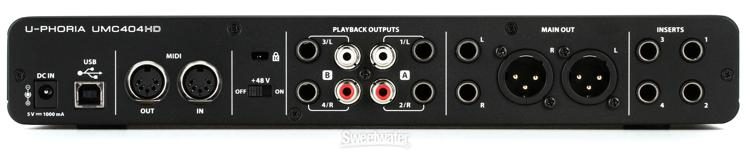
- Behringer umc404hd driver download - this one is a keeper. Getting connected on the rear panel of the umc404hd, you ll find the usb 2.0 port for simple and easy connection to your computer, along with plenty of analog playback options including trs, rca and xlr.
- Hi All, I sent my X-DANTE in for warranty work under an RMA ( RMA: 379496 - CAS-432859-R4H2L9 - CRM:592 if any reps are listening.).
Audiobus is the app that makes the rest of your setup better.
I currently have 4 audio/midi interfaces Akai EIE, NI Komplete 6, Zoom U24 and Behringer UMC 404 HD. I’ve been going crazy building custom diy enclosures for playing live and to try to find the ultimate solution for it in a compact form with 4 in 4 out audio and midi.
The behringer UMC 404 HD was my latest interface to try and I have to say I’m rather disappointed. It is already boxed ready to be returned as it would at times fail to produce audio and I’d get occasional stuttering in the audio.
Issue 1: no audio despite inputs being recognised by software (Audiobus/AUM etc)
Issue 2: occasional stutter in audio
Is anybody else using this line of interfaces?
Have you encountered any issues?
If so, have you identified tha cause and solved the problem?
Cheers
Comments
- edited May 2018
Which iPad, which iOS version, what apps, what host, what polyphony ...?
Or does it stutter even when using only one low-cpu synth?
Can you record in, say, Cubasis/Auria/Audio Evolution? Worked fine with iPhone 6s and iPad Air. iOS 10.3.3
@rs2000 said:
Which iPad, which iOS version, what apps, what host, what polyphony ...?
Or does it stutter even when using only one low-cpu synth?
Can you record in, say, Cubasis/Auria/Audio Evolution?All latest sir. It has nothing to do with cpu or latency as all works fine with 3 other similar interfaces i own.
- edited May 2018
I have the 404HD interface, no problems here. Is there a pattern or specific circumstance that causes issues?
Only weird (but consistent) quirk is that I have to manually set volume with iPad volume buttons. Otherwise, as you say it sometimes has no audio output.
[12.9 ipad pro 2015; iOS 11]
Different versions of iOS devices work fully, in part, or not at all, with different sound cards. This I think is due either to the difference in iOS versions and also even the build of the app using it.
- edited May 2018
@knewspeak said:
Different versions of iOS devices work fully, in part, or not at all, with different sound cards. This I think is due either to the difference in iOS versions and also even the build of the app using it.If this is the case than IOS music is in massive trouble.
I’ve been using Akai EIE for the last 5 years and I’ve never had any issues with any of my ipads: Ipad 4, air 1, air 2 and now IPad Pro 10.5 or with their respective operating systems.
The only reason I’m wanting to upgrade is the physical weight and size but maybe I should just keep it and maybe buy another as a backup. Ironically I just sold my backup one to get the Behringer.
@supadom said:
@knewspeak said:
Different versions of iOS devices work fully, in part, or not at all, with different sound cards. This I think is due either to the difference in iOS versions and also even the build of the app using it.If this is the case than IOS music is in massive trouble.
I’ve been using Akai EIE for the last 5 years and I’ve never had any issues with any of my ipads: Ipad 4, air 1, air 2 and now IPad Pro 10.5 or with their respective operating systems.
The only reason I’m wanting to upgrade is the physical weight and size but maybe I should just keep it and maybe buy another as a backup. Ironically I just sold my backup one to get the Behringer.
I don't think it's a massive problem yet, but just because someone uses a sound card with a certain version of iOS on a iDevice doesn't absolutely guarantee that it will work with all iDevices. Maybe this is what is happening with the Behringer you've got, not working on your device and yet for others it's working fine, maybe because they're different devices or iOS versions. In my case it was an old Lexicon Omega a fellow member couldn't get working with the latest Pros, so I dug mine out to test and yes, it didn't work. So I tested it on all my iPad's, with differing results on each device, only working fully on the original iPad 1.
there's got to be something about 'Class-compliant' USB interfaces that has some room for implementing thing differently or incorrectly. It is strange how some interfaces work differently from others and even work differently across iOS versions.
For sure the 404HD has something weird with volume control. Now I always set it up, then increase the volume (with iPad volume buttons) to 2 notches below max. From there audio output consistently works, and volume knobs on the interface work fine.
Supadom's issue with occasional stuttering is something I've never experienced with my 404HD. I guess it is too late if it's packed up to be returned, but I would be curious about what is causing this.
@Hmtx said:
there's got to be something about 'Class-compliant' USB interfaces that has some room for implementing thing differently or incorrectly. It is strange how some interfaces work differently from others and even work differently across iOS versions.This is what I have found from my limited testing.
What was weird and surprisingly funny I tested using a few DAWs, but when using Cubasis, on the Mini Retina and 10.5 Pro the Lexicon was recognised as a Mac Audio device, but on my iPad 4 it was a WINDOWS Audio device.
@supadom. I had the same problem in regard to issue #1 and ended up sending it back. I found the same volume issue that @Hmtx did but still was unable to get audio through certain apps. Midi controller worked, every bass sim app but none of the vocal apps. I gave it every chance for life but no go.
Air2, latest iOS.I am having an issue with UMC404HD also connected to iOS. My issue is level is so low, it only gets to -48db or so, even though the red clip light on behringer is showing.
That is when I connect via a usb hub to lightning-usb3 connector. WHen I connect directly to lightning-usb3 without hub, the signal is great. I have sporadically gotten it to work with hub as well....I'm thinking it's the order I power cycle?
Would really like it to work with a hub so I can connect one additional device to the hub (this worked with a Tascam interface previously).
My UMC404HD works great with my iPad Pro running the latest version of iOS. Really no problems to speak of here in six months of use. (I have a UMC202HD which also works well). Perhaps a defective unit? Or bad USB cable? (Amazing how often that’s the case...)
As Tovokas mentions, a new high quality cable can work wonders.
I do have an issue with the UMC 1820 where i have to power off and on the unit for ipad to recoginse the audio device. Once its recognised it works.
If anyone has a solution for that i would be grateful.
@audiobumss said:
I am having an issue with UMC404HD also connected to iOS. My issue is level is so low, it only gets to -48db or so, even though the red clip light on behringer is showing.That is when I connect via a usb hub to lightning-usb3 connector. WHen I connect directly to lightning-usb3 without hub, the signal is great. I have sporadically gotten it to work with hub as well....I'm thinking it's the order I power cycle?
Would really like it to work with a hub so I can connect one additional device to the hub (this worked with a Tascam interface previously).
I’ve experienced ‘low volume’ on my new UMC404hd, and through experimentation found that if I plug into my hub in a different order ? The volume is back up to expected levels... going to investigate a bit more,
@d4d0ug said:
@audiobumss said:
I am having an issue with UMC404HD also connected to iOS. My issue is level is so low, it only gets to -48db or so, even though the red clip light on behringer is showing.That is when I connect via a usb hub to lightning-usb3 connector. WHen I connect directly to lightning-usb3 without hub, the signal is great. I have sporadically gotten it to work with hub as well....I'm thinking it's the order I power cycle?
Would really like it to work with a hub so I can connect one additional device to the hub (this worked with a Tascam interface previously).
I’ve experienced ‘low volume’ on my new UMC404hd, and through experimentation found that if I plug into my hub in a different order ? The volume is back up to expected levels... going to investigate a bit more,
Cool, thanks for the update. I’ve returned mine but would be more than happy to get it again since I’ve built a custom box for it.
@supadom said:
@d4d0ug said:
@audiobumss said:
I am having an issue with UMC404HD also connected to iOS. My issue is level is so low, it only gets to -48db or so, even though the red clip light on behringer is showing.That is when I connect via a usb hub to lightning-usb3 connector. WHen I connect directly to lightning-usb3 without hub, the signal is great. I have sporadically gotten it to work with hub as well....I'm thinking it's the order I power cycle?
Would really like it to work with a hub so I can connect one additional device to the hub (this worked with a Tascam interface previously).
I’ve experienced ‘low volume’ on my new UMC404hd, and through experimentation found that if I plug into my hub in a different order ? The volume is back up to expected levels... going to investigate a bit more,
Cool, thanks for the update. I’ve returned mine but would be more than happy to get it again since I’ve built a custom box for it.
No worries, I’m still playing around with it, cant say I’ve had stutter audio yet... but will see....need to give it more of a thrashing...
Im considering getting one of these.
Any updates or recent experiences with these issues?I don’t have the 404, but the bigger 8 channel one. There’s a very tricky thing about it that I had to figure out when I first got it. I still don’t understand why it was this way, but it definitely stumped me with the no audio thing. Turns out I had to turn up the volume on the iPad. For some reason plugging it in caused the iPad volume to zero out, and I truly haven’t ever had an interface that needed me to try to affect the volume with my iPad buttons. My 8 does though. See if this might be your problem too with the 404 maybe.
@boone51 said:
I don’t have the 404, but the bigger 8 channel one. There’s a very tricky thing about it that I had to figure out when I first got it. I still don’t understand why it was this way, but it definitely stumped me with the no audio thing. Turns out I had to turn up the volume on the iPad. For some reason plugging it in caused the iPad volume to zero out, and I truly haven’t ever had an interface that needed me to try to affect the volume with my iPad buttons. My 8 does though. See if this might be your problem too with the 404 maybe.Yep, same issue with the UMC404HD. But its not 100%. Sometimes it will work great without any fiddling with the iPad volume buttons.
And other times I have to add a 24db gain to the input channels just to get a decent volume level on the inputs.
Overall, the interface is pretty solid and sounds great, but it has these quirks. I haven't been bothered to look for firmware updates to see if Behringer has fixed some of this.
- edited January 2019
@Jes I love mine. Had it for several months and besides the above mentioned quirks(ipad volume) its great.
Thank everyone!
@Hmtx is the gain on the inputs problem associated with being plugged into a usb hub or when you are plugged directly into the cck?
Also, does anyone have a problem of low output levels with this interface?hmm, not sure about that @jes I always use a powered USB hub, so I don't know if the problem is fixed by going direct to the CCK.
no problems with low output levels.
I just ordered a UMC404HD and it should be arriving tinnitus. I'll let you know if I have any issues
I've been so close to making this purchase. $150 for a 4/4 is great. Only thing that kills me is it used to be $99 before September!
ha, yep I got it for $99. It really is a great unit, the inputs are clean, and it overall seems very well-built. The quirks are small enough to not really bother me.
I paid $130 for a bundle with some extra cables. If it works, it's still a smokin' deal. I'll probably do an unboxing/setup vid as I did with my Model D....
@Daveypoo said:
I just ordered a UMC404HD and it should be arriving tinnitus. I'll let you know if I have any issuesSuch as a ringing in the ears perhaps?
@Jes said:
@Daveypoo said:
I just ordered a UMC404HD and it should be arriving tinnitus. I'll let you know if I have any issuesSuch as a ringing in the ears perhaps?
Is that what that is?!?!?!?!
F*@&;ing autocorrect....
@Daveypoo said:
@Jes said:
@Daveypoo said:
I just ordered a UMC404HD and it should be arriving tinnitus. I'll let you know if I have any issuesSuch as a ringing in the ears perhaps?
Is that what that is?!?!?!?!
F*@&;ing autocorrect....
hahaha, you wont be getting any tinnitus from this unit if you get the same low level output that others are saying
Very interested in the outcome of any testing...I've had my eyes on the 8 channel version for a while now but have held off on pulling the trigger due to these issues peeps are reporting.
I bought this recently (May 2017) from Harrison Music in Adelaide, on a whim. I was in their store buying something else, and it caught my fancy. It would have cost more than buying it online, but I'm supporting a local business by doing so, and it's there for me to have straight away. No waiting for a delivery that could come any time within the next fortnight, but not actually deliver because I wasn't there at the minute the courier turns up. And I've got a shop to go back to, if I have some problems, and for future purchases where I'd actually like to see the goods before purchase. So, still a win, from my point of view.
What it is
It's an USB audio and MIDI bi-directional interface. That's the nutshell definition, here's a piece-by-piece description:
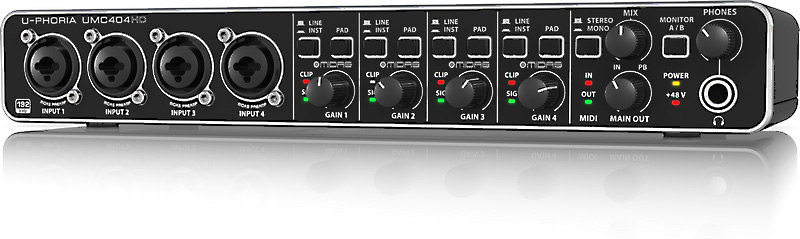
It has four independent mike/instrument/line balanced-input analogue to digital converters (ADC), using combo XLR & ¼″ TRS jacks. While line versus mike is obviously about some rather extreme differences in signal levels, the instrument input mode is very high-impedance, allowing things like electric guitars to be plugged directly in without being muffled (though I haven't been able to check whether they, also, have a suitable amount of gain to do that job, yet, but it's about 20 db more sensitive than the line input, so I'd expect it to be). The input controls are a line/instrument switch (which alters gain and impedance), a pad switch (providing 20 db of signal level reduction), and a variable gain pot. Each input is an individual channel, it's four-channel mono. Each input has a LED to show signal activity of some kind (lighting up at around −18.5 dBFS, a reasonable nominal level for sound capture), and another LED to indicate peaking. It's not defined how that's detected (analogue input levels, digital clipping, etc) but my measurements show that it lights up about −3.5 dBFS, and there seem to be a row of comparators at the front of the main circuitboard near the jacks.
Despite what some people advise, my opinion is that you should set up your gains so that clip lights never come on. Your nominal levels should be sufficiently down from full-scale that it should be near-impossible for any peaks to reach clipping level. With today's equipment, it's feasible, and reasonable, to reserve 20 dB of headroom, and it should be ample to prevent clipping. That is, the equipment is able to handle 20 dB of signal above normal levels, it's not wasted, it's reserved to handle those peaks without distortion. If you have inadequate metering, monitor your loudest audio, turn the gain up until the clip warnings begin to light up, then back it off until they go off and stay off. With a dynamic source, you can expect the green signal lights to blink along with your sound. And with a more consistent sound source (e.g. an organ with continual tones, as opposed to percussive voices, they may stay on while notes are sounding). Or, if you have decent metering on your software, set up for a sensible nominal level with a proper amount of headroom. If you have some odd need to produce material much closer to full-scale, then you should do that as a post-production exercise, where you have good metering, and level controls (limiters, compressors, etc).
As I've said, all channels are independent, four in, four out, none of them have anything to do with each other. If your software handles four channels, then you get to do whatever you like with all of them, separately. It is just an interface, it is not a mixer. Mixing is something that you'd do, with your software, as a separate process when you're editing. You can record four audio sources, as four tracks, mix and pan them how you like. You can play back four audio sources, how you like.
Plugging a tone generator into the ¼″ jacks, I've noticed that switching to instrument mode adds about 20 db of gain, switching the pad in removed about 20 db of gain, giving a 40 dB range, overall. The pad switch also works on the XLR input, but the instrument switch has no effect on it.
Connecting 0 dBu tone into a line jack produces −18dBFS, with the gain all the way down and the pad out. So if you're going to hit it with +4 dBu nominal audio with +18 dB strong peaks, then you're going to need to use a pad to stop it going over full-scale (+4 dBu is a very common industry standard output level, and 18 to 20 dB of headroom is standard for initial capture/recordings, you should only push things closer to the limit during the mastering phases of production).
It's a four-channel line-out digital to analogue converter (DAC), with ¼″ TRS and RCA jacks for balanced and unbalanced connections. They're not actually true balanced outputs, they're what's known as “impedance balanced” (one leg of the output is driven (tip), the other leg (ring) is terminated to ground with a resistance similar to output-driver's impedance).
I can't say that I like impedance-balanced connections. If not done precisely (and it rarely is—a simple resistor to ground does not have the same characteristics as the output stage of the driven half of the allegedly balanced output), CMRR will be poor. You don't have the isolation that a fully-floating (non-ground-referenced) connections will have. You get no signal if someone has made an unbalanced connection by grounding pin two instead of pin three. And some balanced-input equipment doesn't work too well when only one leg is driven (I have one mixer like that). While some may say I'm being picky, haveing the best possible noise-rejection is important when working in electrically noisy environments, especially when you have leads going all over the place.
There's a set of separate XLR & ¼″ TRS jacks for analogue outputs that use an A/B switch for (a) mixed monitoring between all four inputs and channels 1 & 2 output monitoring, or (b) channels 3 & 4 output monitoring, with an output volume control. These switched monitoring outputs also go to a headphone socket, with its own volume control. The A mode lets you mix between analogue monitoring of all the 4 inputs as stereo pairs (channels 1 & 2 being a left & right pair, and channels 3 & 4 being a second left & right pair, or you can hit a mono button to sum them all together) for undelayed monitoring of live signals, and the output from channels 1 & 2 coming back from the DAC. The B mode lets you monitor channels 3 & 4 coming back from the DAC, just by themselves.
What it calls its “main outputs” are what I'd call monitor outputs, it's what you'd listen to in your recording booth (and it's the same signals as its headphones socket monitors). And what it calls its “playback outputs” are what I'd call main outputs (they are the four DAC outputs from each channel, without any switching or level controls).
There are ¼″ TRS insert points on all four input channels (like you'd have on a mixing desk; tip is send, ring is return, sleeve is ground), letting you put effects gadgets between input pre-amp and the ADC (such as compressors, reverbs, etc).
There's MIDI in and out (no thru), but I haven't anything to test that with, at the moment.
The good
I've plugged mike and line levels into it, and it seems to do a nice clean job of capturing them. Monitoring sounds good, headphone output is good, but all the line output levels are quite low (I have to turn my monitor amplifier up higher than I normally do, more about that in the bad section).
The gain pots do appear to be what they say they are, adjusting the gain of the stage, rather than simply being input fader level controls (which they can't be used for, as they do not go all the way down to “off”). It's an interface, not a mixer, you're expected to do that kind of control at the computer.
It can supply +48 volt dc phantom power to the XLR inputs, and I've measured that to be sure that it does actually supply that voltage (some equipment's phantom supply is far less, causing problems with some mikes). And, it doesn't appear to add any noticeable noise to the inputs (I've got a Soundcraft mixer that often adds a hum to any input when the phantom supply is on—it obviously has poor phantom supply filtering and poor CMRR on its inputs). As with most small to middle level audio equipment, it has one master switch for all input channels. It tends to only be expensive high-end gear which have individual phantom power switches, or separate switches for small groups of inputs. I've also tested that the phantom power isn't supplied to the ¼″ jacks (I've encountered one mixing desk that did, and it's a very bad idea), and since this unit used combo XLR & ¼″ TRS jacks, I wanted to be sure it didn't do that.
The device has a 5 volt DC power input socket (and comes with a wall-wart supply), yet doesn't appear to need it. I've got the whole thing running off the one USB port on a friend's Mac computer. Though I suppose that some computers aren't up to the task, or introduce unwanted noises (though various wall-wart supplies do that, too), and having an external supply option is a good idea. When an external supply is connected, it cuts off the supply from the USB port, it's not using both at the same time. Note that the pin-polarity is the opposite from the usual, so don't mix up your plug packs.
It claims to be “built like a tank,” which is often a requirement of audio equipment, considering how people treat them. And it's nice to have equipment that's not covered with sharp edges and corners.
I plugged it into a PC running CentOS 6.9, and everything worked the way I wanted, straight away (no extra drivers needed). (NB: I haven't any MIDI equipment to test that aspect). I have four independent inputs, and four independent outputs. How those outputs are driven depends on what software you're using. Some programs duplicate channels 1 & 2 onto channels 3 & 4, some will ignore channels 3 & 4, other programs give you four-channel audio.
I was going to try this on Fedora 25, but I've been having no end of trouble with that installation on my old laptop, so I'll have to follow that up, later on.
I've plugged this into a friend's Mac computer, and everything appears to work without needing any extra drivers installed. I have four independent inputs, and four independent outputs. How those outputs are driven depends on what software you're using.
I don't really use Windows, anymore, and only have an old laptop with Vista on it, so I don't think I can do a currently worthwhile test on it for Windows. And can't, at the moment, because Windows is refusing to run the software I'd use (Audacity), though I did get it to play some music out through the interface, using already installed music player software.
On both computers, I used it with the free Audacity progam, and various music player programs. Although the hardware supposedly comes with an option to download a free full copy of some software from Traktion, and Behringer (say they) also have various other free downloads, I didn't get anywhere trying to locate that software, and I have no desire to get mired in the mess of software licensing, nor have to contend with Operating System and program incompatibilities.
The hardware is firmware upgradable, and although I've seen people comment that they could upgrade the old UMC404 with the UMC404HD firmware, Behringer has commented that they, also, improved the hardware, and the older hardware wasn't stable at the higher sampling rate. So persue that experiment at your own risk.
The bad
You can only use the XLRs inputs for mike signals, and only use the ¼″ jacks for line, they're not interchangeable (though, it does have XLR and ¼″ line outputs). While I can think of one person who prefers separate mike and line input connectors, I don't. My first mixer let me use either connector for either purpose, the only difference between them was the impedance. And for me, that's the most convenient way to do things. I use professional video equipment, and every input and output is XLR, no matter what the signal level is. It is a reliable connector, and only needs one type of cable to connect anything together. Here, only patchbays use phone jacks. Having to keep an array of leads with different ends is a nuisance, and adaptors are unreliable, not to mention the extra strain they put on connectors with their extra bulk. And phone jack cables are a pest if you have to join two together to make a longer lead. Joiners are unreliable, and an extra thing that you need to keep a supply of.
Related to that is a pet peeve of mine: Different signal levels on inputs and outputs. It can be a right pain to patch together equipment when you find they have configurations like one of my mixers has with: 0 dBu maximum input levels, −6 dBu nominal channel insert levels, +4 dBu nominal output levels. And then you want to connect it to something else which is all over the place, too, and with incompatible levels between the bits you're patching together. When you want to plug in a compressor, for example, you end up over-driving or under-driving one or both of them.
Monitoring sounds good, though is seriously on the low side (on all of the unit's line outputs), I have to turn my amplifier up much higher than I do when monitoring the +4 dBu output of other gear (this is with all the computer's software volume controls set up at maximum). Normally, professional equipment has a +4 dBu output when producing a nominal output level (which is somewhere around 20 dB under full scale—different manufacturers, and different producers, have their own preferences for how much headroom to keep/what nominal level to use). This equipment just about makes it up to 0 dBu when producing audio at full scale (but that's not how you operate professional equipment). So, to produce signals with normal amounts of headroom, it's output is going to be more than 20 dB lower than everything else. If I was to try and connect this unit's output into any professional equipment (such as any analogue recorder), it'd be seriously under-driving it, to the point where it wouldn't do the job (professional balanced-input equipment usually has a nominal input level of +4 dBu, sometimes an input level of 0 dBu, but very rarely a −20 dBu input level). I'd have to put an audio mixer, or pre-amp, between them. Even non-professional equipment usually has a nominal input level of around −10 dBu, so they'd be noticeably under-driven, too. Having said that, I think the main use of this will be putting signals into a computer, probably monitored with a domestic amplifier (which will cope with that low output level), and maybe sending back to an analogue mixer (which only rubbish ones, without input gain controls, should have any real problems with the low level).
I know it's difficult to produce full standard output levels when using equipment running from a low voltage supply (the whole thing runs from 5 volts DC from the computer, or a wall-wart), but it obviously has at least one switch-mode power supply in it to produce the 48 volt phantom supply, so they could have done something similar for the main line-outputs (provide the output stages with a high-enough supply for producing industry-standard output levels).
Although (as an estimate, it looks to be) 1RU high, it's less than 19″ rack unit width, with no straight-forward solution to rack mount it. There are no threaded holes on the sides, and it'd need spacers, as well as wings, or bolting to a tray. You'd have to open it up to see if there was sufficient clearance to add some bolts into the chassis (I've seen people do dumb rack-mounting modifications to equipment, where they've just jammed self-tapping screws through the side, right into other things). It would appear to be designed to be a box to sit on your desk near your computer, rather than something to be mounted with other audio gear. That (one box by your computer) may be desireable for small home studios, but awkward for anything more complex (rack mounting allows you to organise your clutter, out of the way).
I discovered the highly unexpected behaviour that switching in the −20 dB pad adds hiss to the input. I've never experienced that in any other audio equipment. And it's the complete opposite of what I expect—a gain reduction of the pre-amp ought to reduce its noise level, too. I suspect it's just an input attenuator pad, rather than a gain change. I'm yet to discover how noticeable this is in actual use, since I haven't inputted any strong signals, yet, but it is completely obvious when monitoring silent inputs at normal monitoring levels.
The mike inputs are not particularly high gain, I think it's really designed with the idea of capturing singers, or miked instruments, rather than someone casually talking into a mike that's not virtually pressed against their lips. But I've come across plenty of mixers that are like that, too. If you were recording audio books or interviews, I think you'd want something acting as a pre-amp between the mike and this unit, or you're going to have to post-process (it seemed quiet enough to do that, for what it's worth).
I plugged this into a friend's Mac computer, and the system virtually ignores the channel 3 & 4 outputs. Programs can give you four-channel audio (whether they do that, and how they do it, is up to them), but the system only bothers to use channels 1 & 2.
The booklet that comes with it is barely instructive. It gives brief outlines of the controls, but most of that you can work out for yourself with a bit of experimenting. And experimenting is required to work out various things that the book omits.
Additional comments after using this device for some time on a Mac
At some stage, I believe after one of the MacOS updates, I began to have audio break-up issues after one minute of playing any audio. It would start to crackle, then get progressively worse until all it produced was utter distortion. I could stop playback, wait a moment for the computer to reset something, start playback and have another failure start again about one minute in. This was quite repeatable, yet also intermittent. i.e. It wasn't a once-off, nor completely regular. It might happen several times in a row, unplugging and replugging the USB lead might stop the behaviour for a while. And it didn't make any difference whether the device was being powered by the Mac, or its own plug-pack.
Audio capture was fine, it was just playback that was a problem.
Behringer suggested I might have a faulty unit, but I haven't managed to return the device because I couldn't find the purchase receipt. But I'm not the only one to experience this issue. The consensus seems to be that it's a buffer size problem, but there is no way to adjust the buffer size on a Mac, and behringer does not supply their own driver for the Mac, where they could directly address this issue. Adjusting various audio parameters that are available on the Mac, such as bit-rate and bit-depth, don't alleviate the problem. It just resets it for a while.
The Mac is one of those multi-giga-hertz things with multi-processors and oodles of RAM, so it should be quite capable of running the device. And it still fails after a completely new MacOS install, so it shouldn't be down to some random gubbins installed on the Mac.
Since the Mac is a major target for professional and enthusiast audio and video work, behringer really ought to collaborate with Apple, and either have Apple tweak something to support it better, or behringer release a Mac driver specifically for their device.
Behringer Umc404hd Driver Mac Download
In conclusion
The unit is certainly a step above the usual audio inputs and outputs of most computers, in quality, in being able to handle four independent channels, and in being able do so on standard audio connectors, supporting balanced audio, and providing phantom power. The amount of noise added to the signal when the pad switch is engaged is disturbing. The low output-level is a disappointment, but not a show-stopper. For most people, that's probably not even going to be an issue.
Behringer Umc404hd Driver Mac
Pricewise, it seems a good deal, for what it is, and compared against other similar-seeming products.
The ability to use it, on some (*) operating systems, without having to load any special drivers is a definite bonus. Apart from being less hassles to get it going, in the first place, it means that your hardware doesn't suddenly become a useless paperweight when you update or replace your computer system (unlike hardware that had special drivers that were only ever produced for particular versions of operating systems).
Behringer U-phoria Umc404hd Driver Mac
* There are Windows drivers, but I'm not sure whether the device is useable, partially or wholly, without installing them. I'm told it will work in a basic two-channel mode without installing drivers.
Behringer U-phoria Umc404hd Driver Mac

Behringer Umc404hd Driver Download Mac
They make models with less, and more, inputs. I really only had a need for a two-input device, but saw the virtue in buying something more than I currently need. My main uses would be digitisation of pre-existing stereo recordings, or creation of new ones from two microphones. If you intend doing multi-track recording, count up all the channels that you will need as a minimum, and buy something with more.